Take, Eat.
A South Arkansas Ozymandias
We like to run around. I admit that. It’s a privilege I embrace with gratitude, a family trait as true as our worn-out-denim eye color and our aversion to yippy dogs. My parents poked us into the back of the family car and toted us to national parks, to cities we were woefully inept to navigate, and to campsites where we roamed feral, in the way that growing up in the 70s encouraged.
“Arkansas?” Strangers would repeat, and a quiet beat would follow. As a child, I didn’t know how to fill that space. How to capture the essence of home for people who, I later realized, felt a certain way about our state. I’m still unsure.
Because we like to go, our family does, but home matters.
Nowadays we gather up on long weekends, or round-numbered birthdays, or something needs taking or bringing with moving straps and hopefully no rain. Regardless of the catalyst, the chemical reaction is invariable, carbonated. We perch in Mom’s living room on couches and recliners, scooting down when an extra guest pops by and settles in for a spell, like birds on a wire.
We speak of local news and folks my mom connects with our long-ago lives:
You know, her neighbor was that Jameson girl, used to be.
or
You know, down there across from the theater, used to be.
‘Used-to-be’ is a steady refrain, a Duolingo tether for our old selves to grasp the now.
Grandkids’ lives, the ones present and the ones who aren’t, get dissected with gusto. It is the enthusiastic interest of family: earnest, detail-driven queries. Milestones of infancy—walking, eating solid foods—evolve to swim, academics. And now: job offers, romantic partners. The focus varies, the message doesn’t: You matter. Tell me more.
Razorback talk follows a predictable trajectory: the optimism/despair/regroup three-step, a dance we know by heart.
The farm where we gather, where my parents still live, is peppered with core childhood memories—mine, my sister’s, our kids’— that form our family’s UNESCO heritage: go-cart paths, barn swings, clumsy art hung in Papaw’s shop, the zip-line on the pond that thrilled and scared us. We rehash it, quibble over minor details, tease over iced tea.
Come summer we migrate to the patio, where tomatoes ripen on the picnic table and hummingbirds dive bomb the feeder as we talk of rain. Dad gripes over which varmints got in the corn. We are all old, so 7am finds us there unpacking the news over second, third cups of coffee, wondering how the world got so mean. The sun rises on the pasture, and bacon wafts from the kitchen.
And this constant: too much food gets fixed, Mom frets it’s no good, but it is, and leftovers get shuttled into margarine containers and stacked into Walmart bags to take with us later.
What about this pie? Y’all take it. We don’t need it. Take more of that ham.
It’s a sacrament as practiced as communion, and no less holy. It has less to do with calories, more its subtext. Go, but carry home. It fueled my college years, and my sister and I press our own versions into the hands of our college kids now. Let me sustain you.
I have friends whose identities were shaped by changing environments: military families or job upheavals create a looseness, an adaptive fortitude I admire. But as for me, a middle-aged woman with gray roots, I return like a sockeye salmon to where I started: the same bedroom that hosted my footed-pj, Fisher-Price years, grade-school sleepovers with braces and bad bangs, teen calls with boyfriends, whispers and vows, sobs and tissues.
My menagerie of stuffed animals still roosts on the closet’s top shelf, having witnessed my twin bed with Holly Hobby sheets morph to a larger one with space for my husband, who has now spent over thirty years wishing my family’s thermostat ran a few degrees cooler, as my dad’s preferred setting, no matter the season, borders on terrarium. My dear spouse has learned to dress lighter, primed for the Serengeti, and to tape-delay ballgames, because out on the Lockesburg highway, sports channels never seem to come through.
We gather with other kin while we are in town: big, fun, casserole-fueled affairs. Neck-hugs abound and paper plates overflow as dust from the gravel road settles on car bumpers outside. We dodge politics, as our votes likely cancel out theirs. Regardless, there is love and joy, and even though Uncle Joe posts some dubious ideas, he is gentle here, and he brings my son a gift out of kindness. Deer stands and bush hogs get hotly debated—neither of which affect my daily life, yet their familiarity comforts.These topics aren’t as much for me, as they are of me. I carry them in my mind’s pocket like a worry stone, a soothing reminder of my where. And finally, like a benediction, between more neck-hugs and next-times, leftovers get divvied up.
Y’all take these potatoes. There’s plenty. Who wants this cake?
We are running around again soon. Not the grandkids—they’re locked into work and school— but my sister and I, our spouses, Mom and Dad. It’s a big trip. We clutch its preciousness in our hands, know that time is porcelain, and hope our luck holds.
In preparation, I’m reading a book about Egypt, those pharaohs and their grand tombs, and how sand buried them for centuries, preserved in grainy silt like mothballs awaiting careful excavation. Beyond the grandeur, archeologists found villages of the workers who spent their lives crafting such finery: whole communities of families who lived and loved and fussed and gossiped around their workdays, same as us.
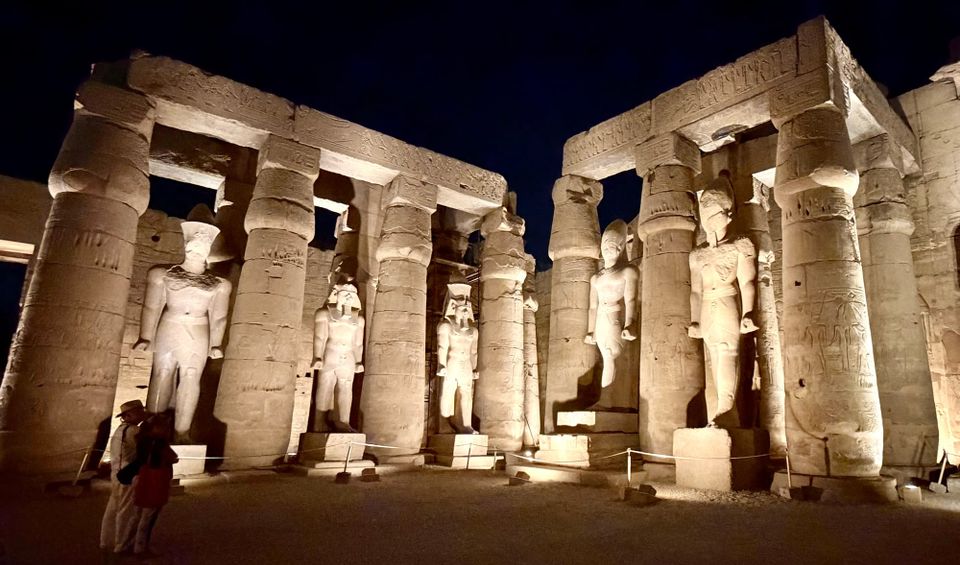
I’m transported, as I read of Ramses, to my family’s trek to the British Museum, where my kids posed, snaggletoothed and slight below his granite image. This massive, seven-ton statue inspired Percy Shelley to pen his poem Ozymandias, the Greeks’ name for this pharaoh who built grandiose monuments bellowing his own greatness. Shelley’s poem served as a cautionary tale of time’s transience, as the ruler’s empire had long since vanished.
Nothing beside remains. Round the decay
Of that colossal Wreck, boundless and bare
The lone and level sands stretch far away
Had my camera lens captured me in that moment at the museum, I would have been laughing, feeling life as evermore thus: me doling out snacks and facts to eager, sunny kids, on and on, into infinity.
Time ambles on. We sense the pull of current events, a painful ripping feeling that seems perilous, capable of real damage. We remind ourselves that the loud ones do the ripping. That much of our country is quietly doing their best, coming together and scooting down on couches, making room and swapping stories and laughing the way family does, at each other and at ourselves—at nothing of consequence, really, except that its nothingness matters. Coming home to familiar storylines reminds us who we are. And sometimes that’s enough, or will have to be.
If our existence fades (spoiler alert: it will), perhaps sand will envelop this precious world we treasure, cocooning our used-to-bes and zip-lines and stuffed animals in a dark protective embrace. Centuries from now, curious souls may arrive to pick at our bones with spoons and tiny whisking brushes. I hope they are less enamored by our Ramses, bellicose and loud, with goldplated, chest-pounding bravado, and instead they bend closer and study the quieter corners where humanity glowed. I like to think they’ll find a little margarine tub in a Walmart bag and come to understand this: it carried the greatest currency, the tender, tethering kind, the one that will endure.
Shelley Russell thwarts melanoma as her day hustle, and writes in between. She is a writer in central Arkansas who has been featured in The New York Times, BBC’s Dear Daughter, The Atlantic Northeast, Kelly Corrigan’s podcast, and the less-literary-but-still-fab Journal of the American Academy of Dermatology. She holds strong feelings about Rick Steves, Twinings tea, and SPF.

Member discussion