Quaint
Lately, my dreams all seem to take place in the home where I’ve never really lived.
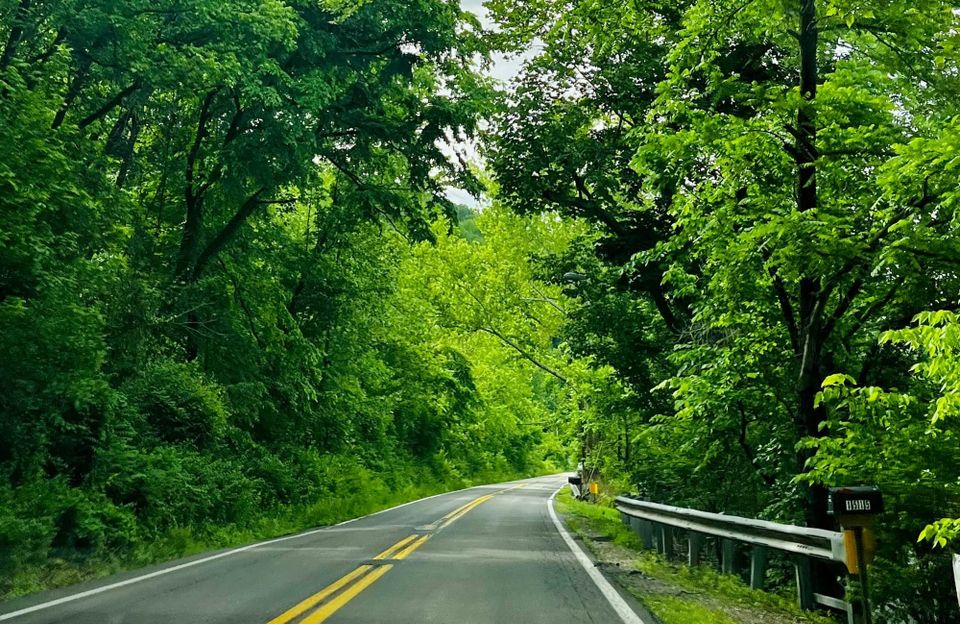
Nearly a century ago, in the lush, misty mountains of West Virginia, my great-grandparents chose to build their home and their farm on a mountain hillside surrounded by trees and bordered by a mercurial little creek. That farm, where my grandma and her brother grew up, also provides the setting for my earliest memories of being alive. I remember skipping in circles around the barn, eating watermelon on the back porch of the old farmhouse, and fishing in the nearby creek with my great-grandma.
I can still clearly imagine the view from that porch, where I stood as a small child gazing up at the endless green hillside that reached beyond my vision. To this day, any time I feel worried or anxious, I try to imagine myself in that place, surrounded by the rivers and the trees that welcomed me into this life.
My family moved to Wisconsin, a land of even prairies and grasslands, when I was about two years old. But every time we traveled to West Virginia to visit my grandma and my great-grandma, it felt like I was returning home after some time away. I felt this way despite having no clear memories of actually living there, but the memories I made on those visits would become enough to justify the way I felt.
The sight of the mountains rising up out of the earth, like enormous sea-green waves suspended in time, struck me as breathtakingly beautiful before I would have possessed the words to even begin to describe that feeling. Altogether, I think the significance of that place to my life must amount to enough to call it a kind of home.
Twice this year, my grandma, nearly ninety years old now, has mentioned that she wants me to have that old farm. She doesn’t remember that she sold the farm over five years ago. I can’t blame her for her faltering memory, and I appreciate the sentiment behind her offer, regardless of how clear or foggy her mind may be when she makes it. But I also can’t help but ache a little bit, knowing that some part of her wanted me to have the farm where she grew up and the place that seems to best represent our family’s deepest roots.
I realize that keeping the place would not have been practical. The water in the well had gone bad, and the house and barn would need to be rebuilt almost in their entirety. There’s no cell phone service out there, the electricity tends to be unreliable, and there’s nothing much for miles around in any direction.
And yet, if my grandma had offered me the farm before, when it was a real possibility, I would have said yes without thinking. I, who manages to overthink most everything, would have accepted without hesitation. Whatever the place might have cost me, for some inexplicable reason, I believe it still would have given me more. In reality, I know that it already has.
Between all of these memories and dreams, and my grandma’s unintentionally empty offers, comes a vague feeling of nostalgia and something uncomfortably akin to helplessness. What can you do when you no longer have any real ownership of a place, but it still has a powerful hold on you?
I only know to capture what I can in writing and in music, to try to reproduce some qualities of the place itself, but also to express the comforting sense I felt as a child that I, too, would be an heir to streams and mountains. Maybe my creative work feels so much more urgent now because I know I can no longer take that expectation for granted.
I think of a particular episode of The Waltons, in which a lumber company threatens to begin a commercial logging operation on Walton’s Mountain. The family must scrape together enough money for legal fees to obtain a deed and prove that they own their land, therefore preserving their woods. Perhaps naively, I wish there were some straightforward way to prove that the mountains, valleys, trees, and creeks belong to all of us. I wish even more that this was not something that needed to be proven.
Now when I capture field recordings for my projects, I can’t help but worry sometimes about whether I am documenting the sounds of our region so that listeners in the future can hear nature as it once sounded, quiet enough to pick up choruses of echoing birdsongs, the trickle of freely flowing creeks, and leaves faintly rustling in the mountain breeze. I have to hope that appreciating and celebrating the simple beauty of these natural things also makes some case for their preservation.
The old family farmhouse still beckons from my dreams: its eggshell white paint faded and peeling, the front steps bending to meet the earth, and weeds and grasses peeking up between separating porch boards. I realize now that I carry that place with me everywhere I go, and I always have.
Just a few years ago, going to college in a city as I’d always dreamed, I tried to distance myself from the places that shaped me. When a classmate in a writing workshop referred to a story I had written as “quaint,” I took it as an insult. At a film festival just last year, when someone asked where I was from, I struggled to give them a straight answer.
I never could have anticipated that I would soon find myself drawing the most essential hope, sustenance, and inspiration from what I once wanted to leave behind. As Earl Hamner Jr. remarked about his own Appalachian home, “A Virginian never really lives anywhere else. He ‘resides abroad’ temporarily.”
At this moment in time, I tend to feel like a John-Boy without any siblings, rooted in the mountains no matter how far I stray from them, guarding a feeling of home, and unable to resist the call of wild quiet.
Stephanie Gemmell is a music producer and writer currently based in the Mid-Atlantic. Her creative writing has been featured in Oxford Public Philosophy, Last Syllable Magazine, The Ekphrastic Review, Just Place Chapbook, Capitol Letters, and in anthologies published by Day Eight and Moonstone Arts.



Member discussion